
A Tiger Petting Zoo
A petting zoo — with tigers? Truly, only in Thailand!
But few children would pass up the chance to pet, stroke and cuddle a real, live, furry tiger cub at a bona fide tiger petting zoo.
Or, as junior put it, “A baby tiger?! Count me in!!!!”
So we trotted off to Tiger Kingdom, 20km or so outside Chiang Mai, Thailand, to stroke tigers, cuddle tiger cubs and experience all things tiger in Thailand.
The tiger petting zoo is just round the corner, in fact, from the home of the elephant artists, elephants that paint pictures live on stage.
Tiger Kingdom is a curious place. Part restaurant. Part breeding programme.
Part, well, tiger petting zoo. A place to get up close and personal with tigers, where you can stroke tigers aged from tiger cubs of two months to young adults of two years.
It’s the sort of place you’d only really find in Thailand.

Tigers are incredible creatures. And tiger cubs, with their dense, heavy fur, almost as soft as a house-cat’s, and their low-pitched mewing, like a tenor kitten, are irresistible.
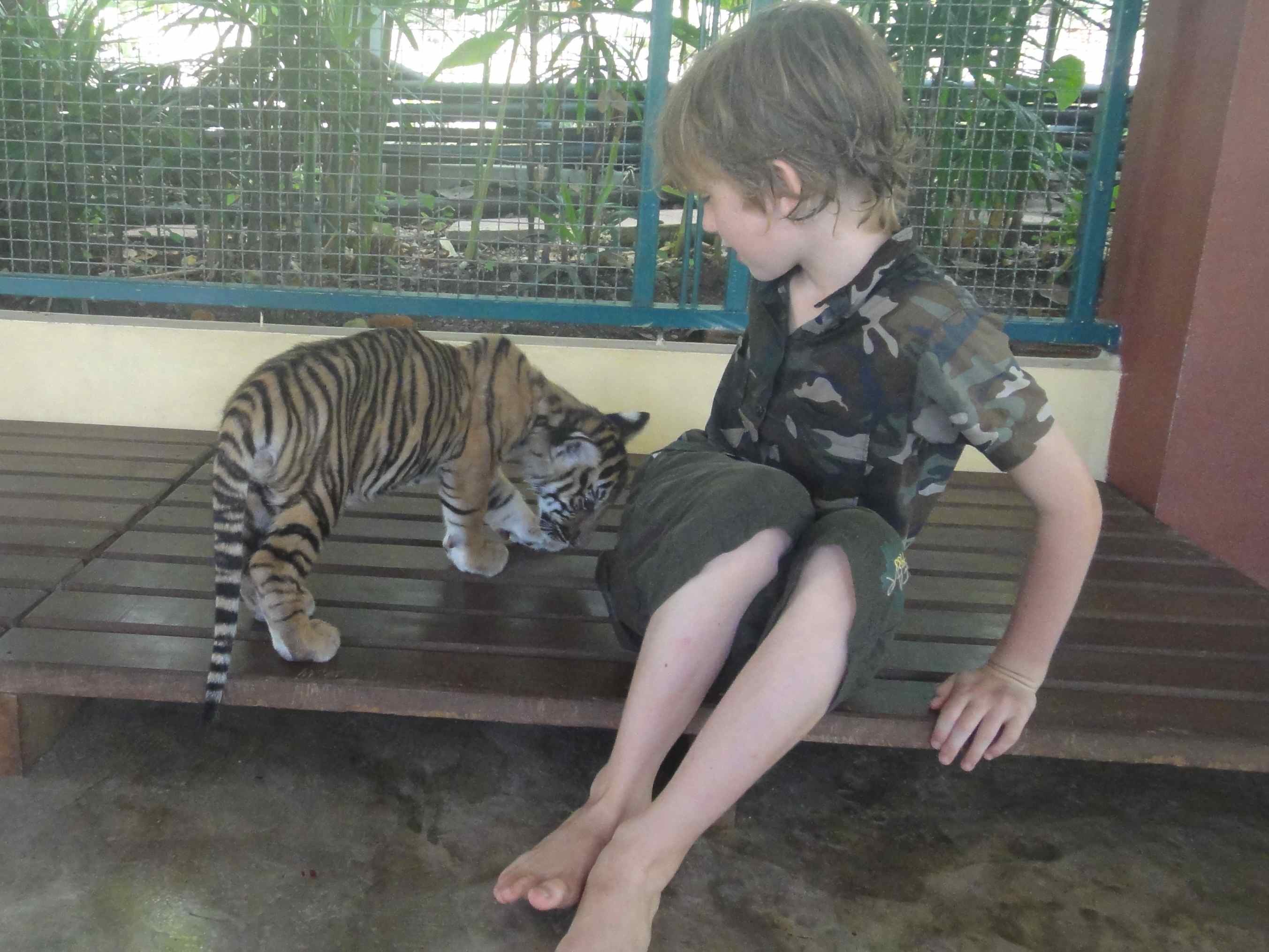
The tiger cubs Z met were only two months old. They bat their paws just like kittens.
But their slinking, long-bodied, low-slung motion reminds one that the bat will one day become a lethal blow.
Z was entranced. Nervous, too: even cute little tigers have serious teeth and claws. But once he got close he loved stroking their soft tiger fur.
And, yes, when you stroke a tiger cub, it purrs.
Now, one of the things I hope to do as we travel the world together is provide Z with experiences he will remember for the rest of his life. And petting a tiger cub should be one of our Thailand highlights.
As he tentatively stroked a snoozing cub’s soft fur, from ears to tail, as you would a house cat, I had that warm, fuzzy feeling every parent gets when children and baby animals combine.
Commingled with the hope that I could shield him from certain harsh realities.
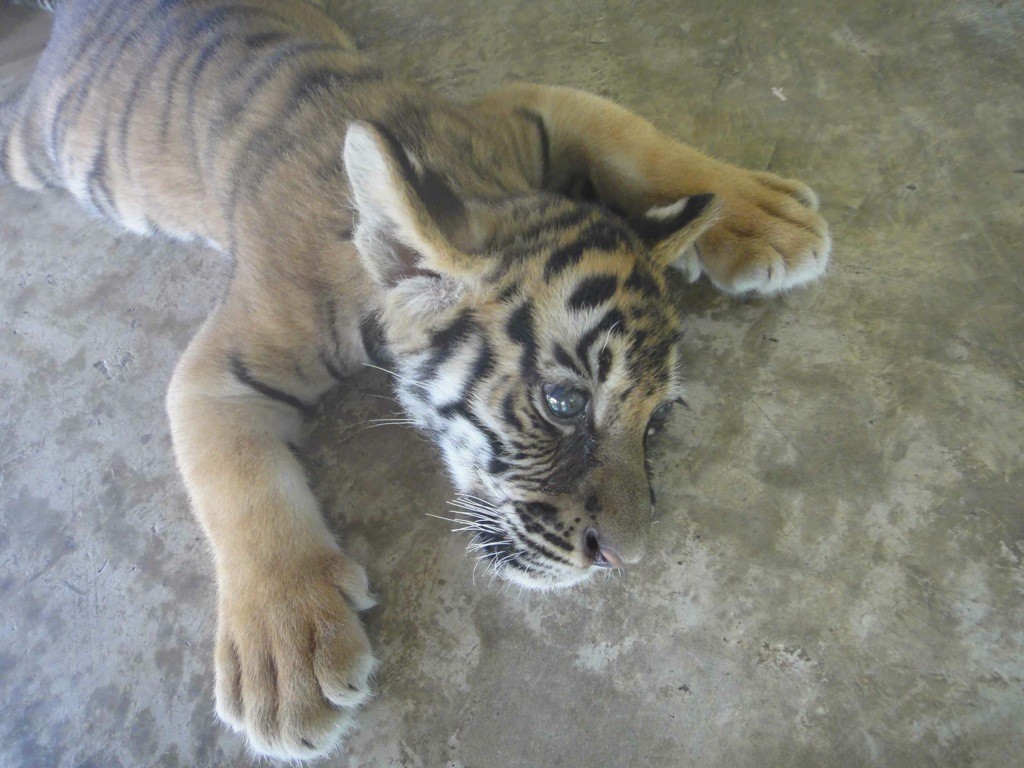
Of which the suspicion that the wobbly-legged little creature you’ve been petting is only wobbly because it’s drugged up to its little eyeballs was one.
As we walked away out of the baby enclosure, on a cute furry high, and through the cages where the tiger cubs’ older relatives reside, that inner glow began to disappear.
You can stroke these grown-up tigers, too. Bathe them. Cuddle them. Pose for pictures reclining like a silent movie star on their sleek muscled backs.
While the tigers’ eyes glaze, heavy-lidded, pupils tiny dots, like so many smackheads under the arches.
Most of them live in narrow wire mesh and polished concrete cages. No stimulus but a table for them to sit on. Like this lioness:
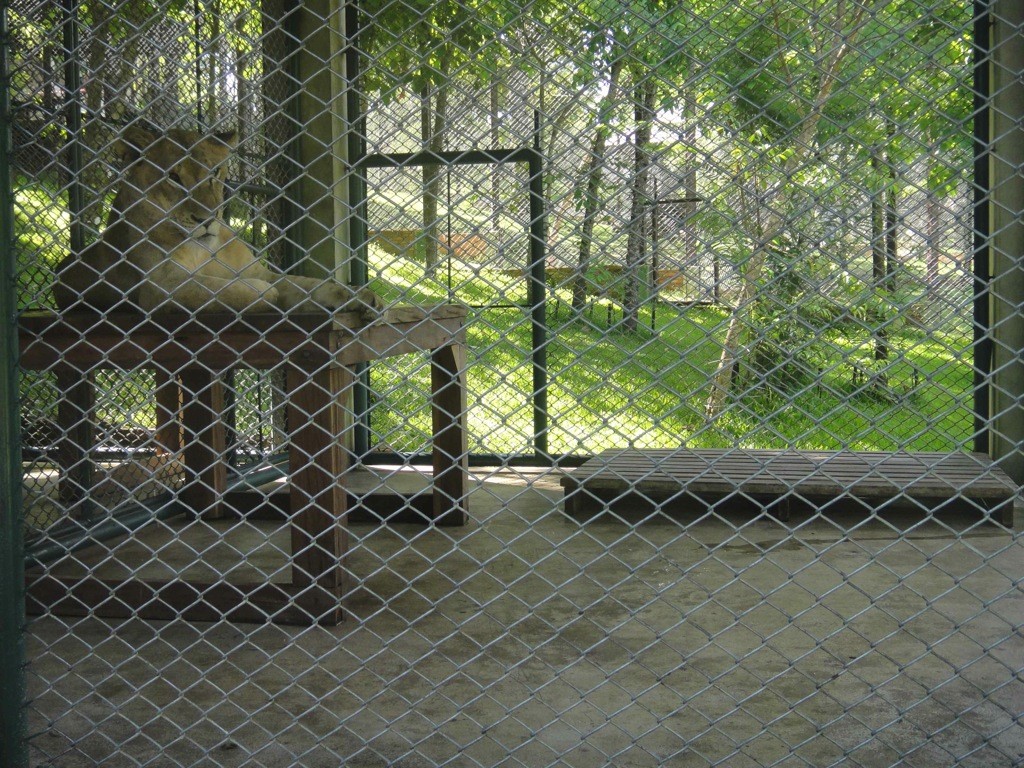
“Mum,” says Z. “This is REALLY cruel. These animals don’t have nearly enough space to move about. They don’t even have the space to mark their territory. It’s like a battery farm for tigers.”
Now, it doesn’t take a rocket scientist to realize that if Siegfried, the professional animal tamer, can be mauled almost to death by a tiger he raised from a cub and trained himself, these critters are most likely in receipt of something rather stronger than stick discipline to stop them turning visitors into lunch.
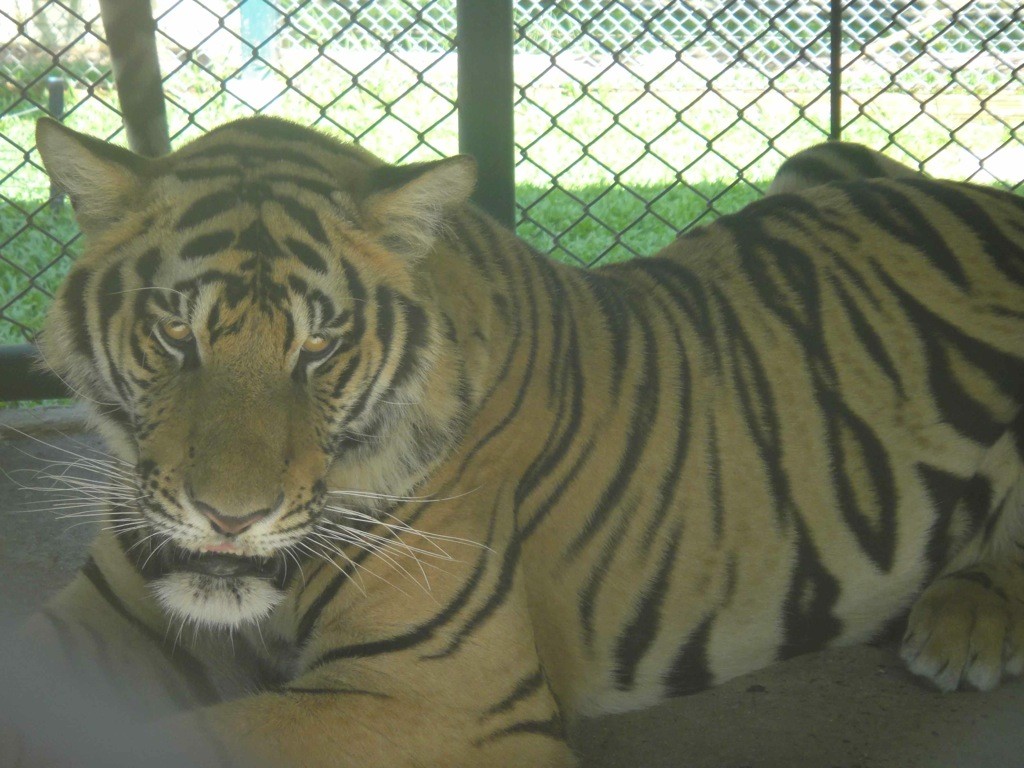
In one enclosure, two tigers, not dosed up for tourist duty, were bathing in a concrete bath. They had, in fact, rather more space than most other creatures there.
Possibly as much as forty square metres between the pair of them.
Tigers are, of course, solitary animals. The natural hunting range of a wild tiger is counted in miles…
This pair of tigers started to fight. It didn’t, to be honest, feel like playing. It felt like two stressed males fighting for dominance over a hideously cramped space.
The atmosphere among the audience, most of them Brits, came close to bear-baiting.
Now, I’m not particularly sensitive to animal rights. There are many people in South-East Asia who live worse lives than these tigers and to apply the standards of the wealthy, sentimental, pet-loving West to Thailand, a country where hundreds of thousands of children work as prostitutes is, IMHO, wildly inappropriate.
And these tigers are clean. Well-fed. Glossy.
This is Thailand. Not Peshawar Zoo.
Still… It shocked me.
More than I expected. Even though I had a good idea the animals would be heavily doped before we went.
I guess it’s because, unlike cows, pigs and, more controversially, horses and dogs, tigers are not domesticated and used for food.
Unlike elephants, which have been used for labour and battle since long before Hannibal (and only retired as a beast of burden with the recent constraints on logging), tigers have never been working animals.
Tigers, even in Thailand, are creatures of the wild. Pure and simple. Hunters.
Tigers, honestly, need space.
Not petting. Not stroking. Not cuddles. Space.
So… What would you have done? Taken your child to stroke tigers? Which is, after all, a once-in-a-lifetime experience…
Or given it a wide berth?
Or am I taking it all much too seriously? And should I, perhaps, stick to wholesome
baby pandas in Chengdu?
What a fantastic memory that will be for Z 🙂
This is an amazing post – thank you for sharing. I think that you take a very thoughtful and responsible view, and clearly you’ve passed it on to your son. Not only did he enjoy the animals, but he was also sensitive to the fact that they’re being mistreated. It’s a complicated concept, but it’s clear he understood it.
Thank you! I was sort of hoping he wouldn’t notice the challenges they were facing, but I think it’s probably a richer experience that he did…
Lovely photographs, what a shame such fabulous animals are being mistreated!
That’s a toughie – or maybe not. I don’t think I’d have gone, but then again I never thought I’d set foot in a zoo again after a horrible experience when I was 10 back in the 1970s and I’m now a member of the Royal Zoological Society of Scotland. I did look into the RZSS beforehand tho and visited their sites before making up my mind. We’re “doing” Florida this year and it’s probably my 5th visit and I’ve always avoided Seaworld, but it’s included in our mega-combi-ultra-because you’re worth it-park ticket so they already have my money – what to do.. what to do?!
Well… We’re doing the artistic elephants. And I guess you’ll probably do Seaworld… He much preferred xorbing, in the end. No ambiguities about rolling down the hill in a giant inflatable ball…
Gorgeous photo of the cub btw… then I read it was drugged (gawd I’m naive) and it’s kinda sad to look at knowing that. I was all thinking “Wow you can pet tiger cubs?!?!?”. Doh!
It was kind of obvious that the big ones had to be. But, yes, I was just thinking “baby tigers, awwww”… And sort of hoping the babies wouldn’t be drugged. But, of course they are…
That’s very sad, they need to have some organization to regulate that, I was recently on an elephant trek in Ko Chang, Thailand, and the trainers whacked the elephants, and stabbed themm with hooks, it was very sad
Wow….
what a post.
It starts with you going “awwww” “wowwww!!” “how lucky!” “jealous!” and “talk about chance in a lifetime…!”
then as you go on, and you read what you write… and see the pictures of the conditions.
Sadness.
Actually holding back tears…
I think I’d have allowed my son to go cuddle one too… you were already there, they had your money. And it IS a once in a lifetime opportunity. I bet you’d not go back again even if you had the chance knowing what you did after!
but yes. I think you’re right. It was more of a richer experience for your son, him recognising the conditions of the animals keeping. Opening his eyes to the cruelty that can be in this world.
Amazing blog entry… so powerful.
I take Thai classes here in Chiang mai and also am a Zoology student back in America.
Only thing I have to say is those tigers are not drugged. Tigers for the most part are nocturnal animals and would only be active at dawn, dusk, and night. They only hunt in the day if hungry or to feed cubs if in the wild.
Seeing as they are in captivity theres no reason for them to want to be awake during the day. Who would want to be awake in the middle of the day in Thailand’s humid hot weather.
The Tigers look lethargic because they are constantly being woken up from their naps to take pictures with customers…
And if it wasnt for the customers, who knows where these tigers would be.
So, I really wish you wouldnt spread rumors about them the park drugging their cats. Had you had gone in the evening, you would have seen wide awake cats.
Hiya,
The ones which weren’t on tourist duty looked awake, and were fighting, as I describe above: roaring, swatting, holding each other under the water.
They also weren’t wobbly legged like the ones on tourist duty. The babies, in particular, were barely capable of walking, had glazed eyes and fell flat on their faces when they attempted to walk.
I suggest you swing by and form your own opinion on the conditions and what subdues the animals to prevent a Siegfried & Roy moment. There’s drowsy or lethargic, and there’s doped…
And, yes, I agree that there is some conservation benefit to places like this (though generally speaking it’s a fairly limited one, as the tigers tend to be cross-bred so useless in conservation terms, and that unwanted adults tend to land up as Chinese medicine)…
Hi MummyT. I was volunteering at Tiger Kingdom for a month but left after a week. They do not drug the tigers but badly beat them into submission. There is no conservation program. Please read my blog for more by following the above link and keep spreading the word that Tiger Kingdom is a terrible place.
Gosh. That’s useful to know. The babies seemed kinda dopy: were they not drugged? Thanks for sharing…
We were just at Tiger Kingdom last week of November (2012) and they were clearly not drugged. Eyes were bright and clear, and while in with the larger tigers, two gentlemen on the outside of the fence snapped a picture with a large camera which set off a huge flash, and the tiger beside us erupted at the fence, hitting it full speed. This happened from a laying position, no hesitation, no wobble. Both guys fell over backwards. Quite a sight. We saw no evidence of abuse, and no evidence of drugs in from cubs (2 months old) to full size. We walked to the back of the facility after being in with the tigers, where there were very few tourist. Every cage we saw was clean, and most of the cats were active. While I don’t advocate keeping any “wild” animal locked up, in this case, the educational value of a threatened/endangered specied like the tiger, I hope outweighs them being captive. I do believe they are healthy, clean, and well fed!
I just visited tiger kingdom a week ago.. And I do not know why you would post such comments.. I have seen drugged tigers and trust me these were far from it.. They ask u not to touch their head or front paws.. While I was in the cage 2 teen tigers stood up and were playing with each other no wobbles, no glassy eyes.. Cubs were walking around and the ones which were a month or so are babies which normally spend most of their time sleeping and eating as do any other animal.. I would never support the temples where they are chained and hardly move.. I do agree that the cages of a few were too small but we must remember that if they were in the wild they would probably be hunted for fur!! I don’t think people should be so quick to judge especially if u compare it with other tiger temples.. On another note.. I don’t know if any of u own cats but they tend to spend most of their time lazing around.. It’s in their nature.. Yes they should be in the wild I totally agree.. But that’s not a safe place for them either nowadays
Really interesting debate…
wow
I really like this post. I think it’s a dilemma a lot of us face. When I first started reading this I thought “wow! They got to pet tigers. That’s incredible. I know my husband and son would love to do that. We will have to go.” But then I kept reading. It’s like a tiger puppy mill. Yes they are keeping the animal population alive, but at what cost. I had a similar thing happen when we were in Beijing. We had an afternoon free and I thought we might check out the pandas at the Beijing Zoo. We had a few other things on our list, so I looked up some reviews and heard how horrible it was. The pandas were OK but the rest of the zoo was awful. In the end we decided not to go. Now I’m wondering if that was a mistake. Would the power of the pandas have out weighed the sadness of their conditions? I don’t know. I guess I’ll have to go back to find out.
Hi there!
We went to Tiger Kingdom last month and there was no evidence of the tiger cubs being drugged. And we were up close and personal with them.
They were active, chasing each other around and having play fights just like I have seen puppies do lots of times. No dopey, glazed eyes. They were curious and moved around the enclosure without any wobbliness (is that a word?)
Not sure about the big ones though….
It makes me so sad to think they would drug them 🙁
I agree with you about the metal and concrete enclosures though – not exactly a natural environment…
In general we stay away from South East Asian zoos (terrible generalisation I know) because the standard of animal enclosures and cares seems to be…er…lacking?
In the end I feel a little conflicted about going to ANY zoo.
On the one hand keeping endangered animals in zoos protects them and offers breeding programs, but on the other…how would you like to be locked up in a cage? – even if it did have a TV and fridge in it?
THanks for your comment, Vickie. They looked very dopey, if not doped, when we were with them — did you see the comment from the girl who volunteered there, btw? She said they weren’t drugged, but they were intimidated and physically abused (the big ones, not the cubs).
One big challenge with these sorts of places is they don’t actually contribute to saving endangered species, because they crossbreed between different populations of tigers, do not document where they came from, etc.
I’m afraid it is people like you, who knew the horrors before even GOING, who will keep this grossly outdated ‘tourist attraction’ running. Why do you, or your son, have the right to know what it feels like to ‘pet a tiger’? Like you say yourself, in your very own words, ‘Tigers, even in Thailand, are creatures of the wild. Pure and simple. Hunters. Tigers, honestly, need space.’ You and your money advocate this type of monstrosity. Imagine if only one day, humans weren’t the higher order species and we were drugged and put on show to be petted. What an incredible life that would be!
Oh, and for future knowledge (I realise this blog is over a year old), the ‘painting elephants’ you went to see got beaten in to submission. That isn’t just a point activists use to try scare those foolish tourists that all of this sickening shows are put on for. Every single ‘domesticated’ elephant has been ripped away from its mother whilst it still needs it mother’s milk and love, and its spirit is then broken, where it is put in to a ‘fencing’ the same size as it so that it cannot move, then it is beaten in to submission using cattle prods and bull hooks. And all of this whilst it is still a baby just so that people like you can go watch it ‘paint’. Natural, huh?
I don’t think I’m advocating it in the way that I write about it, to be fair, Em — I’m describing a visit to something. It was only really when we got there that I realised that, umm, yes, they had to be doped. We don’t go to those sort of places now and I don’t think most people reading the post would want to go either. I also don’t think it’s about the “right” to pet a tiger. It’s about the “opportunity” to pet a tiger. When you get into the question of what one has the right to do the whole question of travel becomes morally dubious.
And, as regards the painting elephants — they’re clearly heavily trained, using the same techniques used on the adults when they were logging elephants. My son, now, doesn’t want to ride elephants or participate in those kind of things. Again, this is a post I’d write differently now, but the whole point of the web is that you leave things up there even when you would (now) write them differently .
That is exactly why I have promised myself never to visit any such attraction. I went to the croc farm in Samut Prakarn and was totally disgusted to see the way crocs and elephants were treated! To top it, they had croc delicacies in the menu! Quite sad.
Yes, I think we’ll be staying away from all these sorts of things in future. With the possible exception of Australia Zoo…
We visited Tiger Kingdom in November 2012, and I’m not sure when the original poster went, but we experienced a completely different Tiger Kingdom. The cats we saw were clearly not drugged, the cubs played like crazy, were alert and sure on their feet, and one of the larger tigers went from relaxed to hitting the side of a fenced area when a camera flash bulb went off. Their eyes were clear and focused, no signs of drugs that we could tell at all. While we don’t enjoy seeing any wild animal caged, I hope that the education and attention it brings to an endangered species, helps offset this. All of the tigers, and one lion, appeared clean and well fed. The staff swears that none of them are drugged, and we believed them based on all that we saw.
Hi, Thanks for your comment.
I’d make two general points: 1) the educational value of Tiger Kingdom is close to zero, and unlicensed breeding programmes endanger endangered species further 2) Any large predator that is rendered safe for cuddles from its natural prey is either traumatised or drugged.
And I’d also invite you to wonder where the cubs go to when they are fully grown…
I really want to go there and do this, but my parents are scared that I’ll be mauled. I told them that I would only do this around the cubs, but still. Do you have any advice? I know that cubs are still dangerous, just not as dangerous as full grown.
I think you’re highly unlikely to be mauled, Kellie, particularly if you stick to the babies. The problem with the place is that it’s grossly exploitative of animals: cruel training, quite possibly doping and it’s highly likely that unwanted adults end up in Chinese medicine. I do understand why you want to do it, which is why we wanted to do it, but these places aren’t good businesses to support. You might want to check out something a bit more sustainable, like volunteering with elephants or at a turtle sanctuary. Hope this helps.
I tried that. But there’s nothing close to where I live. And with the mauling, can you tell my parents that? I’ve been trying to explain that to them. Thanks for the advice, I’ll try again.
all people against animal in zoo then against all time. american for sure who killing millions people in many stupid war.
clean your face before look other
fuck you
Umm, British, actually. So fuck you.
I watched the tigers in Koh Samui this year and it was an incredible experience. My friends didn`t like it and said they were scared. I loved it!
http://nelmitravel.com/royal-bengal-tiger-thailand/
i have just returned from chiang mi and tiger world – i need yto get the word out – it is the most disturbing place i have ever been to – the animals are doped – they have a bamboo caine over there heads all the timer and they are in solitary cageds when they are not posing for pictures – these animals can never be released into the wild – it is all about the tourists – the same as the poor majestic elephants in india that are tid up for years and held in wooden prisons to make them more submissive – please where are ther animal welfare organiations – i cannot rest since seeing the animals in chisang mi///////